
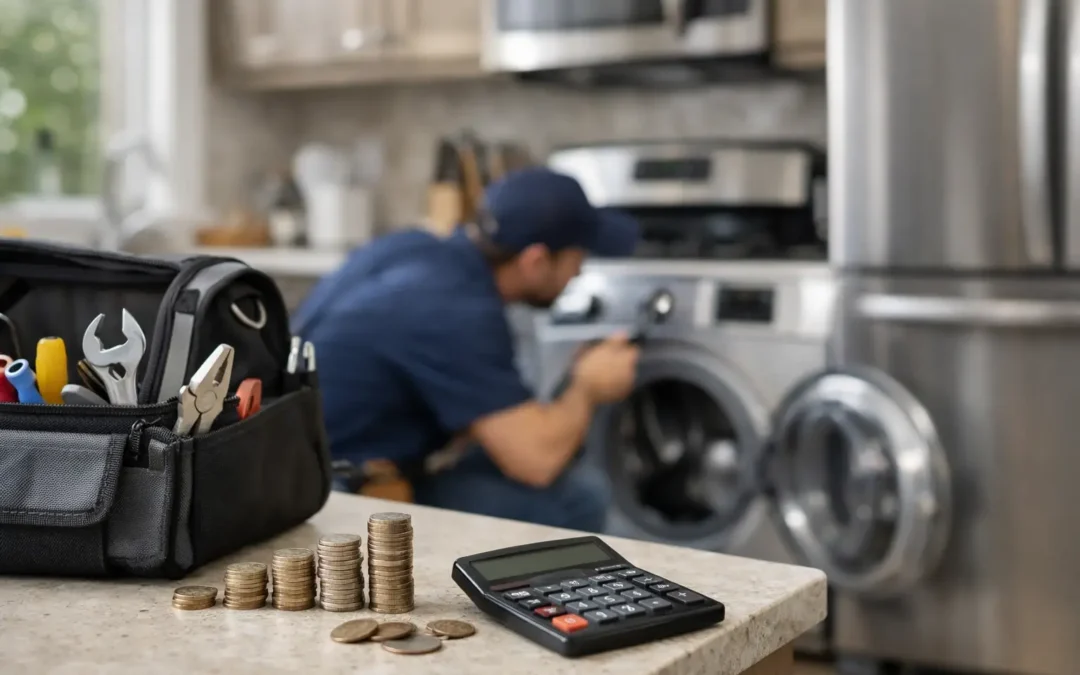
A refrigerator that stops cooling or a washer that will not drain usually creates the same question right away: what is the average cost of appliance repair? Most homeowners want a fast answer, but the honest one is that repair pricing depends on the appliance, the failed part, the brand, and how difficult the diagnosis is. In most cases, appliance repair falls somewhere between about $150 and $500, with some minor fixes below that range and more complex premium-brand repairs going higher.
That range is broad for a reason. A clogged dishwasher drain and a failed built-in refrigerator control board are both appliance repairs, but they are not remotely the same job. If you are trying to decide whether to repair or replace, it helps to understand what drives the final invoice before the technician even opens the machine.
What is the average cost of appliance repair by appliance type?
For standard household appliances, service often starts with a diagnostic or service call fee, then parts and labor are added if repair is approved. Many common repairs land in a practical middle range, especially for appliances that are accessible and use widely available parts.
Refrigerator repair often runs from $200 to $500. If the problem is a thermostat, fan motor, defrost component, or ice maker issue, the repair may stay in the lower or middle part of that range. If the compressor, sealed system, or electronic control is involved, costs can rise quickly.
Washer repair commonly falls between $150 and $400. Drain pumps, door locks, inlet valves, and belts are usually more manageable repairs. Tub bearing issues, motor problems, or control board failures can push the job higher, especially on front-load or high-efficiency models.
Dryer repair often averages $150 to $350. Heating elements, thermal fuses, igniters, rollers, and belts are common repairs. Gas dryers and stacked laundry systems can cost more because access and testing are more involved.
Dishwasher repair is often in the $150 to $350 range. A drain issue, inlet valve problem, circulation pump failure, or latch assembly may be straightforward. Built-in panel-ready models and premium brands can take more time and specialized parts.
Oven, range, and cooktop repairs usually land between $150 and $450. Replacing a bake element or igniter is often less expensive than repairing an electronic control, induction component, or dual-fuel range issue. Professional-style ranges can exceed this range because they are heavier, more complex, and built with premium components.
Microwave repair can range from $150 to $400, depending on whether it is a countertop unit or a built-in model. Built-in and drawer microwaves typically involve more labor and higher-value parts.
Why appliance repair costs vary so much
The biggest reason pricing varies is that the symptom is not the same as the cause. A refrigerator that is warm could have a bad evaporator fan motor, a failed start device, a sensor issue, a sealed system problem, or a main control failure. Those are very different repairs with very different costs.
Parts pricing is another major factor. Standard appliances often use easier-to-source parts at lower price points. Luxury appliances, integrated models, and built-in refrigeration systems may require manufacturer-specific components that cost significantly more and take longer to procure.
Labor also matters. A simple freestanding dryer is easier to access than a built-in refrigerator surrounded by finished cabinetry. The more time required to safely disassemble, diagnose, test, and reinstall components, the more the labor portion of the repair is likely to increase.
Service timing can affect cost too. After-hours service, emergency response, commercial work, and multi-unit property scheduling may be priced differently than a standard residential appointment.
Standard appliances vs. premium and built-in brands
This is where many online price guides miss the mark. They usually quote broad national averages, but they do not separate a basic top-freezer refrigerator from a built-in Sub-Zero or a standard electric range from a professional Wolf unit.
Premium appliances often cost more to repair because they are engineered differently. Built-in refrigeration systems can involve advanced airflow systems, specialty sealed components, integrated controls, and tight installation spaces. Professional cooking appliances may use heavier-duty gas systems, custom igniters, specialty valves, or proprietary electronics.
That does not always mean the repair is a bad investment. In fact, high-end appliance repairs often make more financial sense than replacement because the cost of a new luxury appliance can be substantial. When the repair is completed correctly and backed by a warranty, it can protect a much larger investment in the kitchen or laundry room.
What is usually included in appliance repair pricing?
Most repair invoices are built around three parts: diagnosis, labor, and replacement parts. The diagnostic visit covers travel, inspection, testing, and identification of the failed component or system. Once the problem is confirmed, the technician provides a repair recommendation and cost estimate.
Labor covers the hands-on work required to complete the repair. That includes disassembly, installation of the part, testing, and verification that the appliance is operating properly again. Parts costs depend on the brand, model, and availability.
Some companies also include warranty coverage on completed repairs. That matters more than many homeowners realize. If a company stands behind the work for several months, that gives you more confidence that the issue was diagnosed correctly and repaired to a professional standard.
When repair makes sense and when replacement is smarter
A good repair decision is not based on price alone. It should also consider the appliance’s age, overall condition, brand quality, and replacement value.
Repair usually makes sense when the appliance is still within a reasonable service life, the problem is isolated to one repairable component, and the replacement cost is much higher than the repair. This is especially true for premium brands, built-in appliances, and newer units that are otherwise in good shape.
Replacement may be the better move when the appliance has repeated failures, major system damage, or a repair cost that approaches a large percentage of the cost of a new unit. For lower-cost appliances, even a mid-range repair can be hard to justify. For luxury appliances, that same repair may still be the practical option.
As a general rule, if the repair solves a specific problem and restores several more years of use, it is often worth doing. If the machine is near the end of its life and multiple systems are failing, replacement becomes easier to defend.
Hidden factors that can change the final bill
There are a few details homeowners and property managers should keep in mind when comparing repair estimates. First, not every issue reveals itself immediately. A symptom may point to one failed part, but testing can uncover additional wear or damage once the appliance is opened.
Second, installation conditions matter. Appliances that are stacked, hardwired, built into cabinetry, or located in tight utility spaces may require extra labor. Third, part availability can influence both cost and timeline. If a specialty component has to be ordered, the repair may take longer and carry a higher part price.
This is one reason clear communication matters so much. A professional service company should explain not only the quoted number, but also what that number covers and whether there are any known variables.
How to avoid overpaying for appliance repair
The cheapest quote is not always the lowest total cost. If the diagnosis is wrong, the part is misordered, or the repair is incomplete, you lose time and still have a broken appliance. That is especially risky with refrigeration, laundry equipment, and high-end kitchen appliances where downtime affects daily life immediately.
Look for a company that can diagnose the issue accurately, source the correct part, and complete the repair without handing the process off to multiple vendors. That is even more important for built-in and premium appliances, where specialized training makes a real difference.
If you are in Washington and dealing with a standard or luxury appliance issue, Medvedkov Professional Services handles the full process from diagnosis through repair completion, with clear communication and warranty-backed work. For busy homeowners, landlords, and property managers, that level of ownership often matters as much as the price itself.
The real answer to average repair cost
So, what is the average cost of appliance repair? For many common household appliances, a realistic range is about $150 to $500, with the final price shaped by the part, labor, appliance type, and brand. Simple repairs can come in lower. Complex sealed-system, electronic, or premium-brand repairs can go higher.
The better question is not just what the average costs. It is whether the repair is the right value for your appliance, your schedule, and your home. When the diagnosis is accurate and the repair is done correctly, paying to fix the appliance is often the fastest way to restore normal life with less stress.