
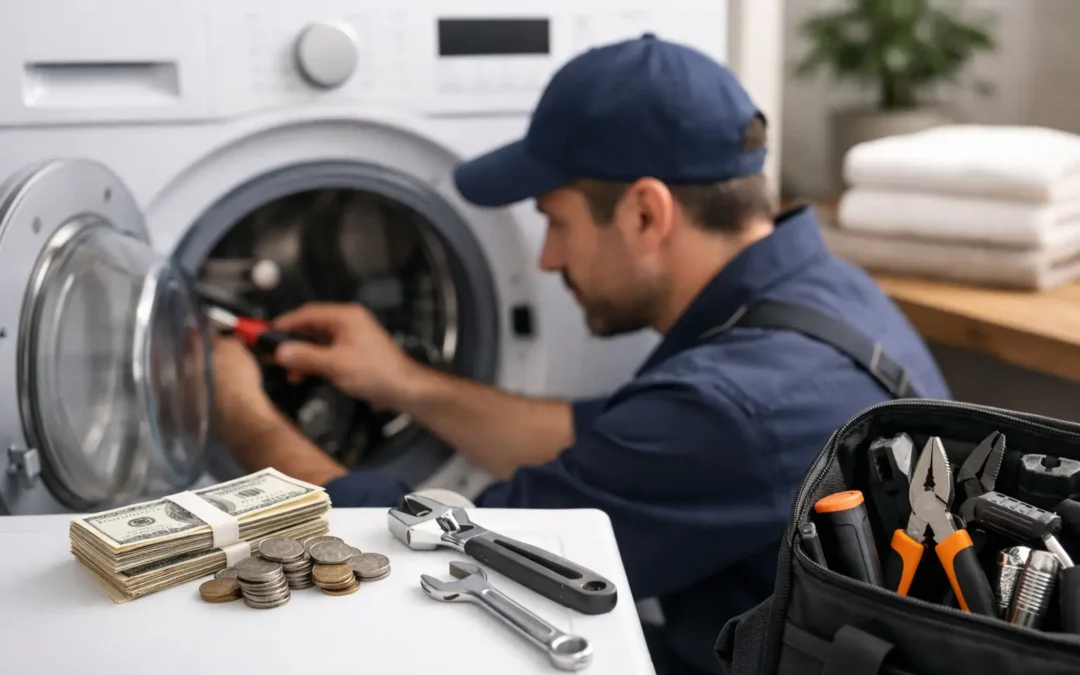
A washer that stops mid-cycle usually creates two problems at once – a pile of wet laundry and an urgent question about washer repair cost. Most homeowners are not comparing repair options for fun. They want to know what the problem is, what the repair will cost, and whether it makes more sense to fix the machine or replace it.
The honest answer is that washer repair pricing depends on the failure, the brand, the age of the appliance, and how much labor is involved in reaching the failed part. A simple drain pump replacement is very different from diagnosing an intermittent control board issue on a high-end unit. That is why accurate diagnosis matters first. Without it, any price quote is only a rough guess.
Average washer repair cost
In most cases, washer repair cost falls somewhere between a minor service call and a more involved mechanical or electrical repair. Homeowners often spend a moderate amount for common issues such as a clogged drain system, faulty lid switch, worn belt, damaged door lock, or failed pump. Costs rise when the repair requires specialty parts, disassembly of major components, or premium-brand expertise.
For many standard residential washers, a straightforward repair may land in the lower to middle range of typical appliance service pricing. More complex problems – especially those involving transmission components, motor issues, suspension systems, or electronic controls – can move the total higher. Front-load washers also tend to be more labor-intensive than basic top-load models, which can affect the final bill.
If the machine is a premium model or a built-in laundry system, parts availability and brand-specific service requirements can also increase repair cost. That does not always mean the repair is a bad value. In many cases, repairing a higher-end washer is still more practical than replacing it with a comparable new unit.
What affects washer repair cost most
The biggest factor is the failed part itself. Some components are inexpensive and quick to replace. Others require more labor or cost significantly more to source. A worn door boot, bad inlet valve, or broken latch may be relatively manageable. A failed control board, stator, motor, or bearing job is a different conversation.
Labor is the next major factor. Two repairs can involve parts with similar prices but very different labor times. Replacing an accessible drain pump is not the same as tearing down a washer to address internal tub or bearing issues. The more disassembly required, the more the repair tends to cost.
Brand matters too. Standard washers are usually easier and less expensive to service than premium or specialty models. Luxury appliances often use proprietary parts and more advanced electronic systems. For homeowners who own high-end equipment, working with a technician who already understands those systems can save time and prevent repeat visits.
Age also plays a role. Older washers may need parts that are discontinued, backordered, or only available through limited suppliers. In some cases, a technician can still complete the repair efficiently. In others, the cost starts climbing because the machine is no longer well-supported.
Repair prices by common washer problem
A washer that will not drain often points to a blocked drain system, failed pump, or lid switch issue. These are common service calls and are often repairable without extreme cost, especially if the machine has no other underlying problems.
A washer that will not spin can be caused by several different failures, including a broken belt, motor issue, clutch problem, door lock failure, or control issue. This is where diagnosis becomes essential. The symptom looks simple, but the repair cost can vary widely depending on the root cause.
Leaks are another example. Sometimes the fix is as simple as a damaged hose or loose connection. Other times, the leak comes from a tub seal, dispenser assembly, drain pump, or door gasket. The final price depends on where the leak is coming from and how much labor it takes to access the damaged part.
If the washer is noisy, shaking violently, or walking across the floor, the problem may involve suspension rods, shocks, bearings, leveling, or load balance. Some of these repairs are straightforward. Others, particularly bearing-related failures, can push the repair cost high enough that replacement becomes worth considering.
Electronic problems tend to be the least predictable. If the machine will not start, stops randomly, flashes error codes, or fails to complete cycles, the issue may involve the control board, user interface, wiring, sensor system, or door lock circuit. These repairs often require careful testing before any part is ordered.
When washer repair cost is worth it
Repair is often the right choice when the washer is still in otherwise good condition, the problem is isolated, and the repair cost is clearly lower than replacement. This is especially true for newer machines and higher-end models. If the appliance fits your space, works well when functioning properly, and has years of useful life left, repair is usually the more practical move.
It also makes sense to repair when the issue is common and well-defined. A bad pump, latch, inlet valve, or suspension component is typically easier to justify than a major internal failure on an aging machine.
For property managers and landlords, repair is often the faster path to getting a unit back in service. Replacing a washer can involve delivery delays, installation coordination, haul-away, and tenant scheduling. A qualified repair can restore operation without that added disruption.
When replacement may make more sense
There are times when washer repair cost gets too close to the value of the machine. If the washer is older, has a history of repeated breakdowns, and now needs an expensive motor, transmission, bearing, or control repair, replacement may be the better investment.
The same is true when multiple problems show up at once. A washer with a leak, spin issue, and control problem is not the same as a washer with one failed part. Even if each issue is technically repairable, the total may no longer be cost-effective.
Parts availability can also force the issue. If critical components are discontinued or delayed for an extended period, replacement may be the more realistic option, especially for busy households that cannot wait.
Why diagnosis matters before quoting price
Many customers call asking for a washer repair cost over the phone, which is understandable. But the same symptom can point to several very different failures. A washer that will not start might need a door lock, a control board, a power correction, or wiring repair. A machine that makes noise might need simple suspension parts or a much larger tub-related repair.
That is why professional diagnosis is not just a first step – it is what prevents wasted money. A technician should identify the actual failure, explain what is needed, and let you know whether the repair is a good value before moving forward.
This is even more important with premium brands and integrated laundry systems. These machines often require brand-specific knowledge, and guessing can get expensive fast.
How to keep washer repair costs from climbing
The best way to control repair cost is to address symptoms early. A small leak, unusual noise, or spin problem rarely improves on its own. Waiting can turn one failed part into damage to surrounding components.
Routine care also helps. Overloading the machine, using the wrong detergent, ignoring vibration, or running a washer with a slow drain can all create larger problems over time. That does not mean every breakdown is preventable, but basic maintenance does reduce wear.
Choosing the right service company matters just as much. Clear communication, accurate diagnosis, proper parts sourcing, and warranty-backed workmanship can make the difference between one completed repair and a series of return visits. For homeowners in Washington dealing with standard or high-end laundry equipment, that level of expertise can save both time and money.
If your washer is not draining, spinning, filling, or starting, the next step is not guessing – it is getting a clear diagnosis from a qualified professional. The right repair should restore reliability, not add more uncertainty to your week.